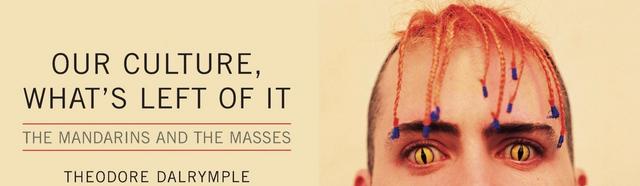
Our Culture, or What's Left of It (Theodore Dalrymple, 2010)
-
What is this but a manifesto for Cool Britannia avant la lettre, an expression of the shallow belief that the new is better than the old merely by virtue of its novelty?
-
And what is political correctness but Newspeak, the attempt to make certain thoughts inexpressible through the reform of language?
-
Like all pacifists, Zweig evaded the question of how to protect the peaceful sheep from the ravening wolves, no doubt in the unrealistic hope that the wolves would one day discover the advantages of vegetarianism.
-
No man was more sensitive than Zweig to the destructive effects upon individual liberty of the demands of large or strident collectivities. He would have viewed with horror the cacophony of monomanias — sexual, racial, social, egalitarian — that marks the intellectual life of our societies, each monomaniac demanding legislative restriction on the freedom of others in the name of a supposed greater, collective good.
-
Macbeth is aware throughout the play that what he does is morally wrong: he never claims (as do so many modern relativists) that fair is foul and foul is fair.
Civilization against itself
[…] in much of the world, poverty is no longer absolute, a lack of food, shelter, or clothing; it is relative. Its miseries are no longer those of raw physical deprivation but those induced by comparison with the vast numbers of prosperous people by whom the relatively poor are surrounded and whose comparative wealth the poor feel as a wound, a reproach, and an injustice.
The Great War destroyed facile optimism that progress toward heaven on earth was inevitable or even possible. The most civilised of peoples proved capable of the most horrific of organised violence. Then came communism and Nazism, which between them destroyed scores of millions of lives, in a fashion that only a few short decades before would have appeared inconceivable. Many of the disasters of the twentieth century could be characterised as revolts against civilisation itself: the Cultural Revolution in China, for example, or the Khmer Rouge in Cambodia. Only ten years ago, in Rwanda, scores of thousands of ordinary people were transformed into pitiless murderers by demagogic appeals over the radio. They achieved a rate of slaughter with their machetes never equalled even by the Nazis with their gas chambers. Who now would bet heavily against such a thing ever happening again anywhere in the world?
Unacknowledged legislators
John Maynard Keynes wrote, in a famous passage in The Economic Consequences of the Peace, that practical men might not have much time for theoretical considerations, but in fact the world is governed by little else than the outdated or defunct ideas of economists and social philosophers. I agree: except that I would now add novelists, playwrights, film directors, journalists, artists, and even pop singers. They are the unacknowledged legislators of the world, and we ought to pay close attention to what they say and how they say it.
Let’s pretend
A ridiculous pas de deux between doctor and patient ensues: the patient pretends to be ill, and the doctor pretends to cure him. In the process, the patient is wilfully blinded to the conduct that inevitably causes his misery in the first place. I have therefore come to see that one of the most important tasks of the doctor today is the disavowal of his own power and responsibility. The patient’s notion that he is ill stands in the way of his understanding of the situation, without which moral change cannot take place. The doctor who pretends to treat is an obstacle to this change, blinding rather than enlightening.
Amorality
When young people want to praise themselves, they describe themselves as ‘nonjudgmental.’ For them, the highest form of morality is amorality.
Story of modern Britain
He was thin and malnourished in the manner I have described. Five feet ten, he weighed just over 100 pounds. He told me what many young men in his situation have told me, that he asked the court not to grant him bail, so that he could recover his health in prison — something that he knew he would never do outside. A few months of incarceration would set him up nicely to indulge in heroin on his release. Prison is the health farm of the slums.
The existence of malnutrition in the midst of plenty has not entirely escaped either the intelligentsia or the government, which of course is proposing measures to combat it: but, as usual, neither pols nor pundits wish to look the problem in the face or make the obvious connections. For them, the real and most pressing question raised by any social problem is: ‘How do I appear concerned and compassionate to all my friends, colleagues, and peers?’ Needless to say, the first imperative is to avoid any hint of blaming the victim by examining the bad choices that he makes. It is not even permissible to look at the reasons for those choices, since by definition victims are victims and therefore not responsible for their acts, unlike the relatively small class of human beings who are not victims.
This is how the British government’s current Food Poverty Eradication Bill should be interpreted. By attempting to tackle the sources of supply rather than those of demand, it will sidestep the question of an entire way of life — a problem that it would take genuine moral courage to tackle — and aim at an easy target instead. The government will increase bureaucracy and regulation without reducing malnutrition. This, in miniature, is the story of modern Britain.
Growing disdainful
And when, having returned from a country in which half the population has been displaced and the infrastructure entirely destroyed, I hear complaints about the difficulty of finding taxis in the rain or delays in delivery of the mail, I am apt to grow disdainful. The problem with having lived too long or too frequently in dangerous situations is that one ceases to care very much about the actual content of the existence one is so anxious to preserve. Danger absolves one of the need to deal with a hundred quotidian problems or to make a thousand little choices, each one unimportant. Danger simplifies existence and therefore — again when chosen, not imposed — comes as a relief from many anxieties.
Deep disgust
Looking around me in the township, I began to see that the spotlessly clean white uniform in which she appeared every day in the hospital represented not an absurd fetish, not the brutal imposition of alien cultural standards upon African life, but a noble triumph of the human spirit—as, indeed, did her tenderly cared-for home. By comparison with her struggle to maintain herself in decency, my former rejection of bourgeois proprieties and respectability seemed to me ever afterward to be shallow, trivial, and adolescent. Until then, I had assumed, along with most of my generation unacquainted with real hardship, that a scruffy appearance was a sign of spiritual election, representing a rejection of the superficiality and materialism of bourgeois life. Ever since then, however, I have not been able to witness the voluntary adoption of torn, worn out, and tattered clothes — at least in public — by those in a position to dress otherwise without a feeling of deep disgust. Far from being a sign of solidarity with the poor, it is a perverse mockery of them; it is spitting on the graves of our ancestors, who struggled so hard, so long, and so bitterly that we might be warm, clean, well-fed, and leisured enough to enjoy the better things in life.
The most important phonomena of the last hundred years
I took with me instead a work by a nineteenth-century French aristocrat, the Marquis de Custine. First published as a series of letters in 1843 under the title La Russie en 1839, the book has since appeared in a multiplicity of formats and abbreviated versions, with various titles in English, suggesting that even its translators and most fervent admirers do not consider it a flawless work of literary art. And yet this travel book is undoubtedly a masterpiece, a work of such penetration and prescience that it is worth reading more than a century and a half after its composition, not only for its antiquarian or historical interest but because of the incomparably brilliant light it sheds on one of the most important phenomena of the last hundred years: the spread of communism throughout the world.
[…]
Visitors reached the palace by boat from Saint Petersburg, and one boat had sunk in a storm on the way to the festival with the loss of all its passengers and crew. But because ‘any mishap [in Russia] is treated as an affair of State’ in Russia, and because ‘to lie is to protect the social order, to speak the truth is to destroy the State,’ there followed ‘a silence more terrifying than the disaster itself.’ In Russia, people of the highest social class — as were the boat’s passengers — could disappear not only without a trace but without comment. Who in such a country could ever feel safe?
Custine appreciated only too well the violence that this remaking of history did to the minds of men, and the consequences it had for their character and behaviour. In order not to look at the palace in which the emperor Paul was murdered, a person had to know that he was killed there; but his whole purpose in not looking at the palace was to demonstrate in public his ignorance of the murder. He thus had not only to assert a lie but also to deny that he knew it was a lie. And all officials — the emperor included — had likewise to pretend that they did not know they were being lied to, or else the whole edifice of falsehood would have come tumbling down. The need always to lie and always to avoid the truth stripped everyone of what Custine called *‘the two greatest gifts of God — the soul and the speech which communicates it.’*People became hypocritical, cunning, mistrustful, cynical, silent, cruel, and indifferent to the fate of others as a result of the destruction of their own souls.
Tocqueville, democracy and governments
But it was from this initial identity of interest that a potential danger arose. By small degrees — though this was only a possibility, not an inevitability — men might cede their independence to a government that represented them, that was believed to have their interests at heart, and that was (after all) composed of men very like themselves. In a passage that united prophetic with psychological insight, Tocqueville (who rightly foresaw that democratic government was destined to spread widely, if not throughout the entire world) described the future soul of man under a seemingly benevolent and democratic government that willingly laboured for the happiness of the people ‘but chose to be the sole agent and only arbiter of that happiness.’ Such a government would ‘supply [the people] with their necessities, facilitate their pleasures, manage their principal concerns.’ What would remain, but to ‘spare them all the care of thinking and all the trouble of living’? When this came to pass, ‘the will of man will not be shattered, but softened, bent and guided.’ Men will not be forced to act, but prevented from acting; the government will not destroy, but prevent a full human existence. It will not tyrannise, but ‘enervate, extinguish and stupefy a people.’ And this is exactly the condition to which a part of the population had been reduced under irreproachably democratic governments.
Living in subsidised housing, its children educated free of charge and its medical bills paid (all for its own good, of course), with an income sufficient to guarantee both enough food and perpetual entertainment in the form of television, all its ‘principal concerns’ are ‘managed,’ just as Tocqueville said they would be, and it is thus spared ‘the care of thinking and all the trouble of living.’
For I work among people who are in effect paupers: and Tocqueville understood, as few modern writers do, that pauperism is above all a psychological, not an economic, condition. And he saw in the English system of social assistance to the poor the same insidious threat to men’s independence of character that he saw, only as a potentiality, in American democracy.
The great dystopias
The great dystopias do not still command our interest because of their technological prescience. The contrivances they describe are often from today’s standpoint laughably naive. H. G. Wells’s time machine is hardly more than an elaborate bicycle made of ivory, nickel, and quartz. The radio reporter’s aluminium hat, filled with transmitting equipment, in Brave New World, strikes us today as ridiculous, despite Huxley’s reputation for scientific foresight. In 1984, Orwell imagines a computer as being full of nuts and bolts, with oil lubricating its operations—more steam engine than motherboard. Yet, this technological naïveté finally does not matter, for the dystopians’ purpose is moral and political.
Huxley surmised that life lived as the satisfaction of one desire after another would result in shallow and egotistical people. True, he had a poor opinion of mankind to start with: ‘About 99.5% of the entire population of the planet are as stupid,’ he once wrote, ‘as the great masses of the English.’
The elites…
The ‘root cause’ of Liberia’s civil war, they said, had been the long dominance of an elite — in the same way, presumably, that poverty is often said to be the ‘root cause’ of crime. The piano was an instrument, both musical and political, of that elite, and therefore its destruction was itself a step in the direction of democracy, an expression of the general will. This way of thinking about culture and civilisation — possible only for people who believe that the comforts and benefits they enjoy are immortal and indestructible — has become almost standard among the intelligentsia of Western societies.
Our decadence
To paraphrase Burke, all that is necessary for barbarism to triumph is for civilised men to do nothing: but in fact for the past few decades, civilised men have done worse than nothing — they have actively thrown in their lot with the barbarians. They have denied the distinction between higher and lower, to the invariable advantage of the latter. They have denied the superiority of man’s greatest cultural achievements over the most ephemeral and vulgar of entertainments; they have denied that the scientific labours of brilliant men have resulted in an objective understanding of Nature, and, like Pilate, they have treated the question of truth as a jest; above all, they have denied that it matters how people conduct themselves in their personal lives, provided only that they consent to their own depravity.
And thus the obvious truth — that it is necessary to repress, either by law or by custom, the permanent possibility in human nature of brutality and barbarism — never finds its way into the press or other media of mass communication.
The philosophic argument is that, in a free society, adults should be permitted to do whatever they please, always provided that they are prepared to take the consequences of their own choices and that they cause no direct harm to others. The locus classicus for this point of view is John Stuart Mill’s famous essay On Liberty: ‘The only purpose for which power can be rightfully exercised over any member of the community, against his will, is to prevent harm to others,’ Mill wrote. ‘His own good, either physical or moral, is not a sufficient warrant.’ This radical individualism allows society no part whatever in shaping, determining, or enforcing a moral code: in short, we have nothing in common but our contractual agreement not to interfere with one another as we go about seeking our private pleasures.
And so long as the demand for material goods outstrips supply, people will be tempted to commit criminal acts against the owners of property. This is not an argument, in my view, against private property or in favour of the common ownership of all goods. It does suggest, however, that we shall need a police force for a long time to come.
One man, one death
In claiming that prohibition, not the drugs themselves, is the problem, […] and many others — even policemen — have said that ‘the war on drugs is lost.’ But to demand a yes or no answer to the question ‘Is the war against drugs being won?’ is like demanding a yes or no answer to the question ‘Have you stopped beating your wife yet?’ Never can an unimaginative and fundamentally stupid metaphor have exerted a more baleful effect upon proper thought. Let us ask whether medicine is winning the war against death. The answer is obviously no, it isn’t winning: the one fundamental rule of human existence remains, unfortunately, one man one death.
The present situation is bad, undoubtedly; but few are the situations so bad that they cannot be made worse by a wrong policy decision.
Upholding virtue & denouncing vice
The problem of upholding virtue and denouncing vice without appearing priggish, killjoy, bigoted, and narrow-minded has become so acute that intellectuals are now inclined either to deny that there is a distinction between the two or to invert their value.
There is no higher word of praise in an art critic’s vocabulary, for example, than ‘transgressive,’ as if transgression were in itself good, regardless of what is being transgressed. Likewise, to break a taboo is to be a hero, irrespective of the content of the taboo. Who is more contemned than he who clings stubbornly to old moral insights?
1950’s audience
But who, one might ask, had the deeper and subtler moral understanding of human relations: the audience of the mid-1950s or that of today? To the 1950s audience it would have been unnecessary to point out that, once a child had been conceived, the father owed a duty not only to the child, but to the mother; that his own wishes in the matter were not paramount, let alone all-important, and that he was not simply an individual but a member of a society whose expectations he had to meet if he were to retain its respect; and that a sense of moral obligation toward a woman was not inimical to a satisfying relationship with her but a precondition of it. To the present-day audience, by contrast, the only considerations in such a situation would be the individual inclinations of the parties involved, floating free of all moral or social constraints. In the modern view, unbridled personal freedom is the only good to be pursued; any obstacle to it is a problem to be overcome.
More democracy
In a democratic age, only the behaviour of the authorities is subject to public criticism; that of the people themselves, never. This is a modern version of Rousseau’s doctrine: if it weren’t for the authorities, the people would be good.
In the psychotherapeutic worldview to which all good liberals subscribe, there is no evil, only victimhood. The robber and the robbed, the murderer and the murdered, are alike the victims of circumstance, united by the events that overtook them. Future generations (I hope) will find it curious how, in the century of Stalin and Hitler, we have been so eager to deny man’s capacity for evil. Every now and again, however, a case arises that stirs a faint memory of this capacity — forgotten soon afterward.
[…] that only the elderly tried to do anything about the situation, though physically least suited to do so. Could it be that only they had a view of right and wrong clear enough to wish to intervene? That everyone younger than they thought something like: ‘Refugees . . . hard life . . . very poor . . . too young to know right from wrong and anyway never taught . . . no choice for them . . . punishment cruel and useless’?
[…] no one in the newspaper acknowledged that an effective police force is as vital a guarantee of personal freedom as a free press, and that the thin blue line that separates man from brutality is exactly that: thin. This is not a decent thing for an intellectual to say, however true it might be.
[…] there is no more heartless saying than that the people get the government they deserve.
Africa
After several years in Africa, I concluded that the colonial enterprise had been fundamentally wrong and mistaken, even when, as was often the case in its final stages, it was benevolently intended. The good it did was ephemeral; the harm, lasting. The powerful can change the powerless, it is true; but not in any way they choose.
The unpredictability of humans is the revenge of the powerless. What emerges politically from the colonial enterprise is often something worse, or at least more vicious because better equipped, than what existed before. Good intentions are certainly no guarantee of good results.